# Search-R1: Train your LLMs to reason and call a search engine with reinforcement learning
Search-R1 is an extension of DeepSeek-R1(-Zero) methods for training reasoning and searching (tool-call) interleaved LLMs. We built upon [veRL](https://github.com/volcengine/verl).
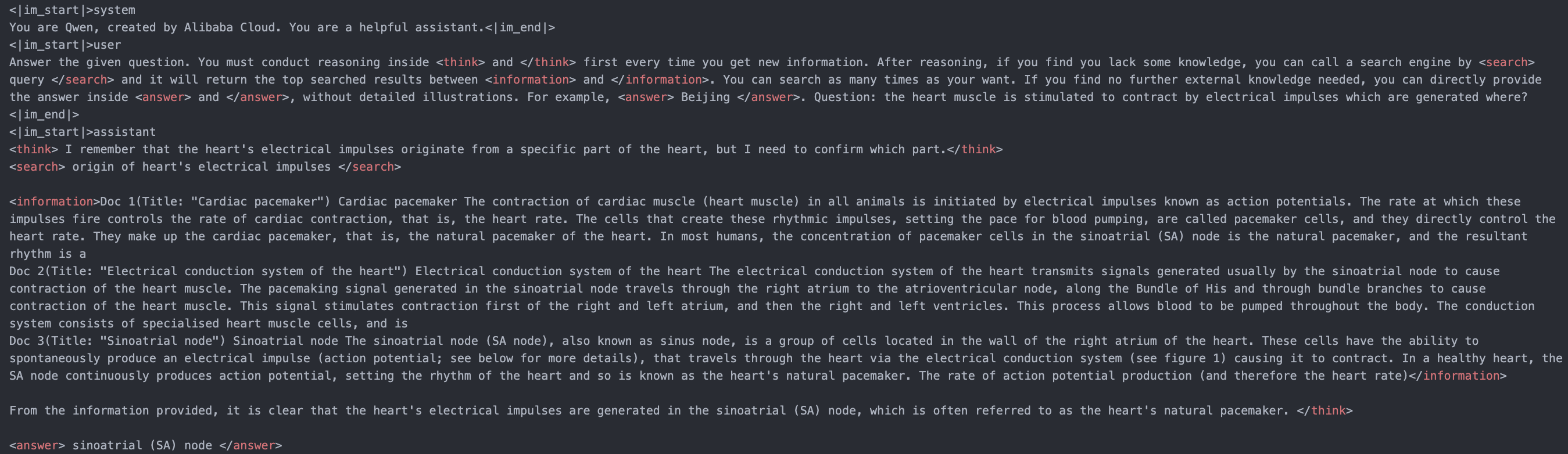
Through RL (rule-based outcome reward), the 3B **base** LLM (both Qwen2.5-3b-base and Llama3.2-3b-base) develops reasoning and search engine calling abilities all on its own.
Paper: [link](https://arxiv.org/pdf/2503.09516); Model and data: [link](https://huggingface.co/collections/PeterJinGo/search-r1-67d1a021202731cb065740f5); Twitter thread: [link](https://x.com/BowenJin13/status/1895544294473109889); Full experiment log 1: [link](https://wandb.ai/peterjin/Search-R1-open); Full experiment log 2: [link](https://wandb.ai/peterjin/Search-R1-nq_hotpotqa_train)
You can refer to this [link](https://github.com/PeterGriffinJin/Search-R1/tree/main/scripts/nq_hotpotqa) for detailed instructions on reproducing the results from the paper.
## Links
- [Installation](#installation)
- [Quick start](#quick-start)
- [Preliminary results](#preliminary-results)
- [Inference](#inference)
- [Use your own dataset](#use-your-own-dataset)
- [Use your own search engine](#use-your-own-search-engine)
- [Features](#features)
- [Ackowledge](#acknowledge)
- [Citations](#citations)
## Installation
### Search-r1 environment
```bash
conda create -n searchr1 python=3.9
conda activate searchr1
# install torch [or you can skip this step and let vllm to install the correct version for you]
pip install torch==2.4.0 --index-url https://download.pytorch.org/whl/cu121
# install vllm
pip3 install vllm==0.6.3 # or you can install 0.5.4, 0.4.2 and 0.3.1
# verl
pip install -e .
# flash attention 2
pip3 install flash-attn --no-build-isolation
pip install wandb
```
### Retriever environment (optional)
If you would like to call a local retriever as the search engine, you can install the environment as follows. (We recommend using a seperate environment.)
```bash
conda create -n retriever python=3.10
conda activate retriever
# we recommend installing torch with conda for faiss-gpu
conda install pytorch==2.4.0 torchvision==0.19.0 torchaudio==2.4.0 pytorch-cuda=12.1 -c pytorch -c nvidia
pip install transformers datasets pyserini
## install the gpu version faiss to guarantee efficient RL rollout
conda install -c pytorch -c nvidia faiss-gpu=1.8.0
## API function
pip install uvicorn fastapi
```
## Quick start
Train a reasoning + search LLM on NQ dataset with e5 as the retriever and wikipedia as the corpus.
(1) Download the indexing and corpus.
```bash
save_path=/the/path/to/save
python scripts/download.py --save_path $save_path
cat $save_path/part_* > $save_path/e5_Flat.index
gzip -d $save_path/wiki-18.jsonl.gz
```
(2) Process the NQ dataset.
```bash
python scripts/data_process/nq_search.py
```
(3) Launch a local retrieval server.
```bash
conda activate retriever
bash retrieval_launch.sh
```
(4) Run RL training (PPO) with Llama-3.2-3b-base.
```bash
conda activate searchr1
bash train_ppo.sh
```
## Preliminary results
(1) The base model (llama3.2-3b-base) learns to call the search engine and obtain improved performance.

(2) The base model (Qwen2.5-7b-base) can learn to conduct multi-turn search engine calling and reasoning with RL.

## Inference
#### You can play with the trained Search-R1 model with your own question.
(1) Launch a local retrieval server.
```bash
conda activate retriever
bash retrieval_launch.sh
```
(2) Run inference.
```bash
conda activate searchr1
python infer.py
```
You can modify the ```question``` on line 7 to something you're interested in.
## Use your own dataset
### QA data
For each question-answer sample, it should be a dictionary containing the desired content as below:
```
data = {
"data_source": data_source,
"prompt": [{
"role": "user",
"content": question,
}],
"ability": "fact-reasoning",
"reward_model": {
"style": "rule",
"ground_truth": solution
},
"extra_info": {
'split': split,
'index': idx,
}
}
```
You can refer to ```scripts/data_process/nq_search.py``` for a concrete data processing example.
### Corpora
It is recommended to make your corpus a jsonl file, where each line (a dictionary with "id" key and "contents" key) corresponds to one passage. You can refer to ```example/corpus.jsonl``` for an example.
The "id" key corresponds to the passage id, while the "contents" key corresponds to the passage content.
For example:
```
{"id": "0", "contents": "Evan Morris Evan L. Morris (January 26, 1977 \u2013 July 9, 2015) was a lobbyist for Genentech and its parent corporation Roche in Washington."}
...
{"id": "100", "contents": "Three years later, when the United States Exploring Expedition to little-known portions of the globe was organised under Charles Wilkes, Hale was recommended, while yet an undergraduate."}
...
```
**Index your corpora (optional).**
If you would like to use a local retriever as the search engine, you can index your own corpus by:
```
bash search_r1/search/build_index.sh
```
You can change ```retriever_name``` and ```retriever_model``` to your interested off-the-shelf retriever.
## Use your own search engine
Our codebase supports local sparse retriever (e.g., BM25), local dense retriever (both flat indexing with GPUs and ANN indexing with CPUs) and online search engine (e.g., Google, Bing, etc). More details can be found [here](https://github.com/PeterGriffinJin/Search-R1/tree/main/docs/retriever.md).
The main philosophy is to launch a local or remote search engine server separately from the main RL training pipeline.
The LLM can call the search engine by calling the search API (e.g., "http://127.0.0.1:8000/retrieve").
You can refer to ```search_r1/search/retriever_server.py``` for an example of launching a local retriever server.
## Features
- Support local sparse retrievers (e.g., BM25). ✔️
- Support local dense retrievers (both flat indexing and ANN indexing) ✔️
- Support google search / bing search / brave search API and others. ✔️
- Support off-the-shelf neural rerankers. ✔️
- Support different RL methods (e.g., PPO, GRPO, reinforce). ✔️
- Support different LLMs (e.g., llama3, Qwen2.5, etc). ✔️
## Acknowledge
The concept of Search-R1 is inspired by [Deepseek-R1](https://github.com/deepseek-ai/DeepSeek-R1) and [TinyZero](https://github.com/Jiayi-Pan/TinyZero/tree/main).
Its implementation is built upon [veRL](https://github.com/volcengine/verl) and [RAGEN](https://github.com/ZihanWang314/RAGEN/tree/main).
We sincerely appreciate the efforts of these teams for their contributions to open-source research and development.
We thank Jinsung Yoon and Sercan Arik for insightful discussions.
## Citations
```bibtex
@article{jin2025search,
title={Search-R1: Training LLMs to Reason and Leverage Search Engines with Reinforcement Learning},
author={Jin, Bowen and Zeng, Hansi and Yue, Zhenrui and Wang, Dong and Zamani, Hamed and Han, Jiawei},
journal={arXiv preprint arXiv:2503.09516},
year={2025}
}
```