 271d92dcaa
* add metaworld

* smol update

Signed-off-by: Jade Choghari <chogharijade@gmail.com>

* update design

* Update src/lerobot/envs/metaworld.py

Co-authored-by: Copilot <175728472+Copilot@users.noreply.github.com>
Signed-off-by: Jade Choghari <chogharijade@gmail.com>

* update

* small changes

* iterate on review

* small fix

* small fix

* add docs

* update doc

* add better gif

* smol doc fix

* updage gymnasium

* add note

* depreciate gym-xarm

* more changes

* update doc

* comply with mypy

* more fixes

* update readme

* precommit

* update pusht

* add pusht instead

* changes

* style

* add changes

* update

* revert

* update v2

* chore(envs): move metaworld config to its own file + remove comments + simplify _format_raw_obs (#2200)

* update final changes

---------

Signed-off-by: Jade Choghari <chogharijade@gmail.com>
Co-authored-by: Copilot <175728472+Copilot@users.noreply.github.com>
Co-authored-by: Steven Palma <imstevenpmwork@ieee.org>
81 lines
4.2 KiB
Plaintext
81 lines
4.2 KiB
Plaintext
# Meta-World
|
||
|
||
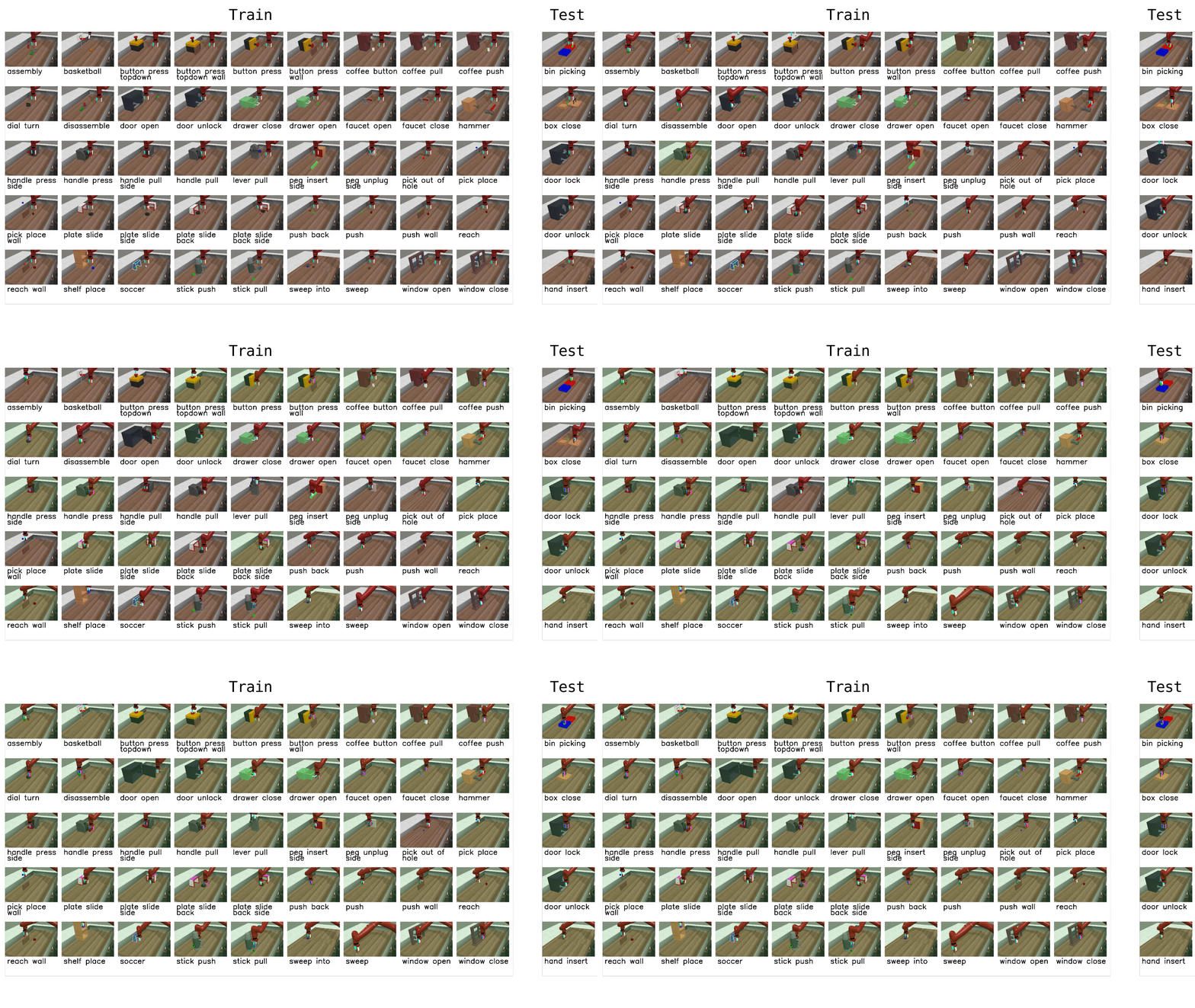
Meta-World is a well-designed, open-source simulation benchmark for multi-task and meta reinforcement learning in continuous-control robotic manipulation. It gives researchers a shared, realistic playground to test whether algorithms can _learn many different tasks_ and _generalize quickly to new ones_ — two central challenges for real-world robotics.
|
||
|
||
- 📄 [MetaWorld paper](https://arxiv.org/pdf/1910.10897)
|
||
- 💻 [Original MetaWorld repo](https://github.com/Farama-Foundation/Metaworld)
|
||
|
||
|
||
|
||
## Why Meta-World matters
|
||
|
||
- **Diverse, realistic tasks.** Meta-World bundles a large suite of simulated manipulation tasks (50 in the MT50 suite) using everyday objects and a common tabletop Sawyer arm. This diversity exposes algorithms to a wide variety of dynamics, contacts and goal specifications while keeping a consistent control and observation structure.
|
||
- **Focus on generalization and multi-task learning.** By evaluating across task distributions that share structure but differ in goals and objects, Meta-World reveals whether an agent truly learns transferable skills rather than overfitting to a narrow task.
|
||
- **Standardized evaluation protocol.** It provides clear evaluation modes and difficulty splits, so different methods can be compared fairly across easy, medium, hard and very-hard regimes.
|
||
- **Empirical insight.** Past evaluations on Meta-World show impressive progress on some fronts, but also highlight that current multi-task and meta-RL methods still struggle with large, diverse task sets. That gap points to important research directions.
|
||
|
||
## What it enables in LeRobot
|
||
|
||
In LeRobot, you can evaluate any policy or vision-language-action (VLA) model on Meta-World tasks and get a clear success-rate measure. The integration is designed to be straightforward:
|
||
|
||
- We provide a LeRobot-ready dataset for Meta-World (MT50) on the HF Hub: `https://huggingface.co/datasets/lerobot/metaworld_mt50`.
|
||
- This dataset is formatted for the MT50 evaluation that uses all 50 tasks (the most challenging multi-task setting).
|
||
- MT50 gives the policy a one-hot task vector and uses fixed object/goal positions for consistency.
|
||
|
||
- Task descriptions and the exact keys required for evaluation are available in the repo/dataset — use these to ensure your policy outputs the right success signals.
|
||
|
||
## Quick start, train a SmolVLA policy on Meta-World
|
||
|
||
Example command to train a SmolVLA policy on a subset of tasks:
|
||
|
||
```bash
|
||
lerobot-train \
|
||
--policy.type=smolvla \
|
||
--policy.repo_id=${HF_USER}/metaworld-test \
|
||
--policy.load_vlm_weights=true \
|
||
--dataset.repo_id=lerobot/metaworld_mt50 \
|
||
--env.type=metaworld \
|
||
--env.task=assembly-v3,dial-turn-v3,handle-press-side-v3 \
|
||
--output_dir=./outputs/ \
|
||
--steps=100000 \
|
||
--batch_size=4 \
|
||
--eval.batch_size=1 \
|
||
--eval.n_episodes=1 \
|
||
--eval_freq=1000
|
||
```
|
||
|
||
Notes:
|
||
|
||
- `--env.task` accepts explicit task lists (comma separated) or difficulty groups (e.g., `env.task="hard"`).
|
||
- Adjust `batch_size`, `steps`, and `eval_freq` to match your compute budget.
|
||
- **Gymnasium Assertion Error**: if you encounter an error like
|
||
`AssertionError: ['human', 'rgb_array', 'depth_array']` when running MetaWorld environments, this comes from a mismatch between MetaWorld and your Gymnasium version.
|
||
We recommend using:
|
||
|
||
```bash
|
||
pip install "gymnasium==1.1.0"
|
||
```
|
||
|
||
to ensure proper compatibility.
|
||
|
||
## Quick start — evaluate a trained policy
|
||
|
||
To evaluate a trained policy on the Meta-World medium difficulty split:
|
||
|
||
```bash
|
||
lerobot-eval \
|
||
--policy.path="your-policy-id" \
|
||
--env.type=metaworld \
|
||
--env.task=medium \
|
||
--eval.batch_size=1 \
|
||
--eval.n_episodes=2
|
||
```
|
||
|
||
This will run episodes and return per-task success rates using the standard Meta-World evaluation keys.
|
||
|
||
## Practical tips
|
||
|
||
- If you care about generalization, run on the full MT50 suite — it’s intentionally challenging and reveals strengths/weaknesses better than a few narrow tasks.
|
||
- Use the one-hot task conditioning for multi-task training (MT10 / MT50 conventions) so policies have explicit task context.
|
||
- Inspect the dataset task descriptions and the `info["is_success"]` keys when writing post-processing or logging so your success metrics line up with the benchmark.
|