 abde7be3b3
* initial commit

* change device in test

* do detailed import

* adhere to python 3.11 syntax

* fix autodocstring

* additionally

* do same in other files

* add model. prefix to all keys in state dict

* use dummy stats

* add pi05

* also shorten action_steps

* fix test

* all test pass! and fix tokenizer max length between 05 and 0

* remove test

* fix transformer dependency

* fix test

* split pi0 and pi05 policy in seperate files

* fix test

* fix push to hub test

* add some comments, license and readme

* remove warning in config

* add pi05 to factory

* remove check

* rename action_horizon to chunk_size

* clean up padding of state and action (more in line with lerobot pi0)

* add openpi image transforms for training and add more flexibility to _preprocess_images similar to lerobot pi0

* fix key match from pytorch state dict (similar keys to openpi implementation now)

* also for pi05

* update to python 3.11

* revert to openpi transformer replace python 3.11

* fix(modeling pi0): nit  warning message

* use safeauto_docstring

* fix: remove unused param

* fix from pretrained

* add preprocess tests

* also compile forward method

* Do not add model prefix to normalization

* use same name for action and state dim as lerobot pi0 and remove fixed image keys

* load from pretrained_path

* temp: hardcode base model

* fix override self.pretrained_path = None overwrite

* rename to loss

* remove additional image augmentations, lerobot dataset already does this

* Add docs

* put tests in test folder

* Add test to instatiate all base models

* go back to python 3.10

* update docs

* adapt docs pi05

* change docs: finetune base model options

* minor docs fixes and dependencies

* remove todo

* cast float64 to float32 for mps

* skip if no transformers

* fix tests

* add new models to modelcard

* add back init

* fix circular input

* feat: only run pi test on GPU

* remove require_nightly_gpu

* replace decorator test_pi0_openpi

* rename action_dim, state_dim to max_action_dim, max_state_dim

* fix doc and constants

* cleanup tests

* fix from pretrained

* fix tests

* add comment pi0 pi05 tests, add image features to pi0 pi05 hub tests

* fix, state is included in language not in flow head

* Move test to specific folder

* and paligemma task with newline

* remove add_special_tokens, not needed

* feedback pr

* Remove previous pi0 and rename pi0_openpi and pi05_openpi

* Add Quantile stats to LeRobotDataset (#1985)

* - Add RunningQuantileStats class for efficient histogram-based quantile computation
- Integrate quantile parameters (compute_quantiles, quantiles) into LeRobotDataset
- Support quantile computation during episode collection and aggregation
- Add comprehensive function-based test suite (24 tests) for quantile functionality
- Maintain full backward compatibility with existing stats computation
- Enable configurable quantiles (default: [0.01, 0.99]) for robust normalization

* style fixes, make quantiles computation by default to new datasets

* fix tests

* - Added DEFAULT_QUANTILES=[0.01, 0.10, 0.50, 0.90, 0.99] to be computed for each features instead of being chosen by the user
- Fortified tests.

* - add helper functions to reshape stats
- add missing test for quantiles

* - Add QUANTILE normalization mode to normalize the data with the 1st and 99th percentiles.
- Add QUANTILE10 normalization mode to normalize the data with the 10th and 90th percentiles.

* style fixes

* Added missing lisence

* Simplify compute_stats

* - added script `augment_dataset_quantile_stats.py` so that we can add quantile stats to existing v3 datasets that dont have quatniles
- modified quantile computation instead of using the edge for the value, interpolate the values in the bin

* rename pi0/pi05 files

* Remove open pi patch and use custom transformer branch for now

* renaming

* fix

* Revert "fix"

This reverts commit 1ea65730ac2cbca6e5869df734fbd4392561b3c6.

* fix naming

* feet(pi0/pi0.5): add pipeline (#2009)

* feat(processor): convert openpi model with processor

* TODO: Make test works

* fix(modeling_pi0openpi): update attention mask value and time scaling; improve task handling in tests

- Changed the attention mask value from `self.config.attention_mask_value` to a fixed value of `-2.3819763e38`.
- Updated time scaling in the `sample_noise` method to use a constant factor of `0.999` and an offset of `0.001`.
- Enhanced task handling in tests to ensure proper formatting and batch size consistency.
- Cleaned up commented-out test code for clarity.

* refactor(pi0): rename PI0OpenPIConfig and PI0OpenPIPolicy to PI0Config and PI0Policy

- Updated imports and references throughout the codebase to reflect the new naming convention.
- Introduced a new processor file for PI0 to handle pre-processing and post-processing steps.
- Adjusted tests to utilize the renamed classes, ensuring consistency and functionality.
- Enhanced clarity and maintainability by removing outdated naming conventions.

* refactor(pi05): rename PI0OpenPIPolicy to PI0Policy and update configuration

- Renamed `PI0OpenPIPolicy` to `PI0Policy` for consistency with naming conventions.
- Updated the `PI05OpenPIConfig` to include a new `tokenizer_max_length` attribute and changed the normalization mode for state from `MEAN_STD` to `QUANTILES`.
- Simplified model initialization in `PI05OpenPIPolicy` by removing unused `dataset_stats` parameter.
- Added a new processor class for `Pi05PrepareStateTokenizerProcessorStep` with `@dataclass` for improved readability.
- Introduced a test script to compare the integration of the PI0OpenPI policy with the original implementation, ensuring local testing compatibility.

* feat(processor): convert openpi model with processor

* TODO: Make test works

* fix(modeling_pi0openpi): update attention mask value and time scaling; improve task handling in tests

- Changed the attention mask value from `self.config.attention_mask_value` to a fixed value of `-2.3819763e38`.
- Updated time scaling in the `sample_noise` method to use a constant factor of `0.999` and an offset of `0.001`.
- Enhanced task handling in tests to ensure proper formatting and batch size consistency.
- Cleaned up commented-out test code for clarity.

* refactor(pi0): rename PI0OpenPIConfig and PI0OpenPIPolicy to PI0Config and PI0Policy

- Updated imports and references throughout the codebase to reflect the new naming convention.
- Introduced a new processor file for PI0 to handle pre-processing and post-processing steps.
- Adjusted tests to utilize the renamed classes, ensuring consistency and functionality.
- Enhanced clarity and maintainability by removing outdated naming conventions.

* refactor(pi05): rename PI0OpenPIPolicy to PI0Policy and update configuration

- Renamed `PI0OpenPIPolicy` to `PI0Policy` for consistency with naming conventions.
- Updated the `PI05OpenPIConfig` to include a new `tokenizer_max_length` attribute and changed the normalization mode for state from `MEAN_STD` to `QUANTILES`.
- Simplified model initialization in `PI05OpenPIPolicy` by removing unused `dataset_stats` parameter.
- Added a new processor class for `Pi05PrepareStateTokenizerProcessorStep` with `@dataclass` for improved readability.
- Introduced a test script to compare the integration of the PI0OpenPI policy with the original implementation, ensuring local testing compatibility.

* refactor(pi05): update imports and rename configuration classes

- Changed imports to reflect the new naming convention for PI05 configuration and policy classes.
- Renamed `PI05OpenPIConfig` to `PI05Config` and `PI05OpenPIPolicy` to `PI05Policy` for consistency.
- Introduced a new processor file for PI05, implementing pre-processing and post-processing steps.
- Updated tests to utilize the renamed classes, ensuring functionality and consistency across the codebase.

* update(pi05): increase tokenizer_max_length for improved processing

- Changed the `tokenizer_max_length` from 48 to 200 to enhance the model's capability in handling longer sequences.
- This adjustment aims to improve the overall performance and flexibility of the PI05 configuration.

* add default for state (max_state_dim)

* correct naming

* fix import

* cleanup code

* remove unused test

* us quantiles for action

* move to device

* remove discrete state assert

* fix pi05 test

* move pi05 to device

* use base models in comparison tests

* small renames for tests

* change number of tokens pi05 test

* fix openpi tokenization in test

* fix hub test

* fix test

* assert lerobot vs openpi tests

---------

Co-authored-by: Pepijn <pepijn@huggingface.co>

* add headers

* add back previously removed imports

* update if statement load processor with dataset stats

* remove to avoid circular import

* inject dataset stats for pretrained models

* check normalization before applying

* add link to  quantile augument script

* fix(policies): transformers import for ci in PI0 & PI05 (#2039)

* fix(policies): transformers import for ci in PI0

* fix(policies): transformers import for ci in PI05

* test(processor): fix expected raise when normalization types are missing (#2040)

* switch normalization order pipeline for pi05

* Fix/quantiles script (#2064)

* refactor augment stats with quantiles script
add parallelization for faster processing
shift the quantile normalization between -1 1

* fix replay buffer tests

* fix comment

* overwrite the pipeline normalization features with the policy features

* remove double normalization overwrite

* cleanup from pretrained

* remove typo

* also set norm_map

* fix(augment_quantiles) images incorrectly divided by 255

* clamp quantiles

* link to lerobot base models

* rename tests

* encorperate PR feedback

* update docstring for RunningQuantileStats

* update doc links

* Revert "clamp quantiles"

This reverts commit 172207471c8f2cb62958e9a9e6a0535ba3ff67d4.

* fix self.paligemma

* fix tests related to quantiles that were scaled to [0,1], the new range is [-1, 1]

* fix libero doc and use different transformer branch

* use fix branch instead of feat

* update results libero

* add new line

* fix formatting

* precommit

* update results libero

* update libero doc

* update title

* final changes

* add quantiles to test

* run pre commit

---------

Signed-off-by: Steven Palma <imstevenpmwork@ieee.org>
Co-authored-by: Michel Aractingi <michel.aractingi@huggingface.co>
Co-authored-by: Adil Zouitine <adilzouitinegm@gmail.com>
Co-authored-by: Steven Palma <imstevenpmwork@ieee.org>
Co-authored-by: Steven Palma <steven.palma@huggingface.co>
167 lines
7.3 KiB
Plaintext
167 lines
7.3 KiB
Plaintext
# LIBERO
|
||
|
||
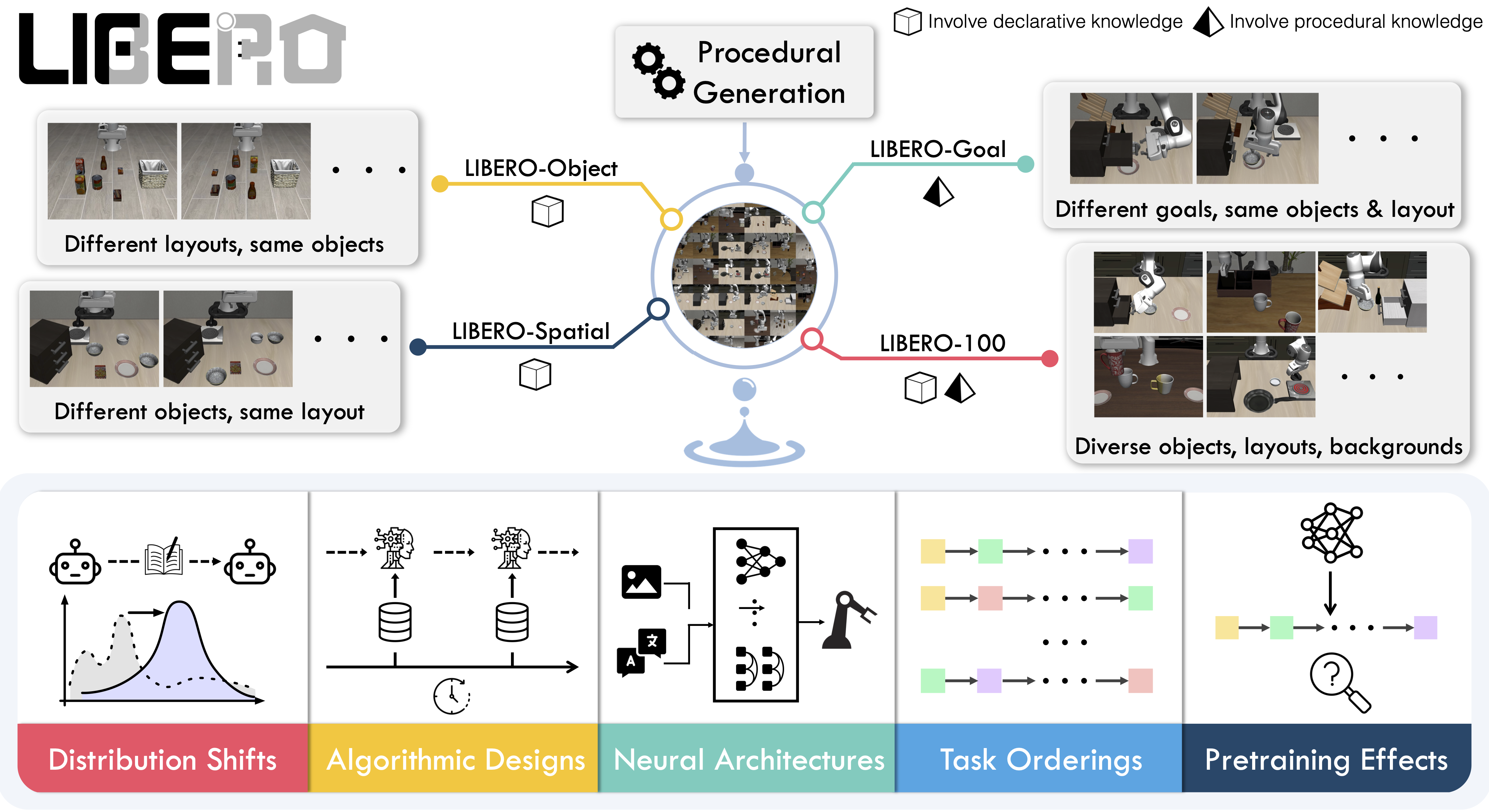
**LIBERO** is a benchmark designed to study **lifelong robot learning**. The idea is that robots won’t just be pretrained once in a factory, they’ll need to keep learning and adapting with their human users over time. This ongoing adaptation is called **lifelong learning in decision making (LLDM)**, and it’s a key step toward building robots that become truly personalized helpers.
|
||
|
||
- 📄 [LIBERO paper](https://arxiv.org/abs/2306.03310)
|
||
- 💻 [Original LIBERO repo](https://github.com/Lifelong-Robot-Learning/LIBERO)
|
||
|
||
To make progress on this challenge, LIBERO provides a set of standardized tasks that focus on **knowledge transfer**: how well a robot can apply what it has already learned to new situations. By evaluating on LIBERO, different algorithms can be compared fairly and researchers can build on each other’s work.
|
||
|
||
LIBERO includes **five task suites**:
|
||
|
||
- **LIBERO-Spatial (`libero_spatial`)** – tasks that require reasoning about spatial relations.
|
||
- **LIBERO-Object (`libero_object`)** – tasks centered on manipulating different objects.
|
||
- **LIBERO-Goal (`libero_goal`)** – goal-conditioned tasks where the robot must adapt to changing targets.
|
||
- **LIBERO-90 (`libero_90`)** – 90 short-horizon tasks from the LIBERO-100 collection.
|
||
- **LIBERO-Long (`libero_10`)** – 10 long-horizon tasks from the LIBERO-100 collection.
|
||
|
||
Together, these suites cover **130 tasks**, ranging from simple object manipulations to complex multi-step scenarios. LIBERO is meant to grow over time, and to serve as a shared benchmark where the community can test and improve lifelong learning algorithms.
|
||
|
||
|
||
|
||
## Evaluating with LIBERO
|
||
|
||
At **LeRobot**, we ported [LIBERO](https://github.com/Lifelong-Robot-Learning/LIBERO) into our framework and used it mainly to **evaluate [SmolVLA](https://huggingface.co/docs/lerobot/en/smolvla)**, our lightweight Vision-Language-Action model.
|
||
|
||
LIBERO is now part of our **multi-eval supported simulation**, meaning you can benchmark your policies either on a **single suite of tasks** or across **multiple suites at once** with just a flag.
|
||
|
||
To Install LIBERO, after following LeRobot official instructions, just do:
|
||
`pip install -e ".[libero]"`
|
||
|
||
### Single-suite evaluation
|
||
|
||
Evaluate a policy on one LIBERO suite:
|
||
|
||
```bash
|
||
lerobot-eval \
|
||
--policy.path="your-policy-id" \
|
||
--env.type=libero \
|
||
--env.task=libero_object \
|
||
--eval.batch_size=2 \
|
||
--eval.n_episodes=3
|
||
```
|
||
|
||
- `--env.task` picks the suite (`libero_object`, `libero_spatial`, etc.).
|
||
- `--eval.batch_size` controls how many environments run in parallel.
|
||
- `--eval.n_episodes` sets how many episodes to run in total.
|
||
|
||
---
|
||
|
||
### Multi-suite evaluation
|
||
|
||
Benchmark a policy across multiple suites at once:
|
||
|
||
```bash
|
||
lerobot-eval \
|
||
--policy.path="your-policy-id" \
|
||
--env.type=libero \
|
||
--env.task=libero_object,libero_spatial \
|
||
--eval.batch_size=1 \
|
||
--eval.n_episodes=2
|
||
```
|
||
|
||
- Pass a comma-separated list to `--env.task` for multi-suite evaluation.
|
||
|
||
### Policy inputs and outputs
|
||
|
||
When using LIBERO through LeRobot, policies interact with the environment via **observations** and **actions**:
|
||
|
||
- **Observations**
|
||
- `observation.state` – proprioceptive features (agent state).
|
||
- `observation.images.image` – main camera view (`agentview_image`).
|
||
- `observation.images.image2` – wrist camera view (`robot0_eye_in_hand_image`).
|
||
|
||
⚠️ **Note:** LeRobot enforces the `.images.*` prefix for any multi-modal visual features. Always ensure that your policy config `input_features` use the same naming keys, and that your dataset metadata keys follow this convention during evaluation.
|
||
If your data contains different keys, you must rename the observations to match what the policy expects, since naming keys are encoded inside the normalization statistics layer.
|
||
This will be fixed with the upcoming Pipeline PR.
|
||
|
||
- **Actions**
|
||
- Continuous control values in a `Box(-1, 1, shape=(7,))` space.
|
||
|
||
We also provide a notebook for quick testing:
|
||
Training with LIBERO
|
||
|
||
## Training with LIBERO
|
||
|
||
When training on LIBERO tasks, make sure your dataset parquet and metadata keys follow the LeRobot convention.
|
||
|
||
The environment expects:
|
||
|
||
- `observation.state` → 8-dim agent state
|
||
- `observation.images.image` → main camera (`agentview_image`)
|
||
- `observation.images.image2` → wrist camera (`robot0_eye_in_hand_image`)
|
||
|
||
⚠️ Cleaning the dataset upfront is **cleaner and more efficient** than remapping keys inside the code.
|
||
To avoid potential mismatches and key errors, we provide a **preprocessed LIBERO dataset** that is fully compatible with the current LeRobot codebase and requires no additional manipulation:
|
||
👉 [HuggingFaceVLA/libero](https://huggingface.co/datasets/HuggingFaceVLA/libero)
|
||
|
||
For reference, here is the **original dataset** published by Physical Intelligence:
|
||
👉 [physical-intelligence/libero](https://huggingface.co/datasets/physical-intelligence/libero)
|
||
|
||
---
|
||
|
||
### Example training command
|
||
|
||
```bash
|
||
lerobot-train \
|
||
--policy.type=smolvla \
|
||
--policy.repo_id=${HF_USER}/libero-test \
|
||
--policy.load_vlm_weights=true \
|
||
--dataset.repo_id=HuggingFaceVLA/libero \
|
||
--env.type=libero \
|
||
--env.task=libero_10 \
|
||
--output_dir=./outputs/ \
|
||
--steps=100000 \
|
||
--batch_size=4 \
|
||
--eval.batch_size=1 \
|
||
--eval.n_episodes=1 \
|
||
--eval_freq=1000 \
|
||
```
|
||
|
||
---
|
||
|
||
### Note on rendering
|
||
|
||
LeRobot uses MuJoCo for simulation. You need to set the rendering backend before training or evaluation:
|
||
|
||
- `export MUJOCO_GL=egl` → for headless servers (e.g. HPC, cloud)
|
||
|
||
## Reproducing π₀.₅ results
|
||
|
||
We reproduce the results of π₀.₅ on the LIBERO benchmark using the LeRobot implementation. We take the Physical Intelligence LIBERO base model (`pi05_libero`) and finetune for an additional 6k steps in bfloat16, with batch size of 256 on 8 H100 GPUs using the [HuggingFace LIBERO dataset](https://huggingface.co/datasets/HuggingFaceVLA/libero).
|
||
|
||
The finetuned model can be found here:
|
||
|
||
- **π₀.₅ LIBERO**: [lerobot/pi05_libero_finetuned](https://huggingface.co/lerobot/pi05_libero_finetuned)
|
||
|
||
We then evaluate the finetuned model using the LeRobot LIBERO implementation, by running the following command:
|
||
|
||
```bash
|
||
python src/lerobot/scripts/eval.py \
|
||
--output_dir=/logs/ \
|
||
--env.type=libero \
|
||
--env.task=libero_spatial,libero_object,libero_goal,libero_10 \
|
||
--eval.batch_size=1 \
|
||
--eval.n_episodes=10 \
|
||
--policy.path=pi05_libero_finetuned \
|
||
--policy.n_action_steps=10 \
|
||
--output_dir=./eval_logs/ \
|
||
--env.max_parallel_tasks=1
|
||
```
|
||
|
||
**Note:** We set `n_action_steps=10`, similar to the original OpenPI implementation.
|
||
|
||
### Results
|
||
|
||
We obtain the following results on the LIBERO benchmark:
|
||
|
||
| Model | LIBERO Spatial | LIBERO Object | LIBERO Goal | LIBERO 10 | Average |
|
||
| -------- | -------------- | ------------- | ----------- | --------- | -------- |
|
||
| **π₀.₅** | 97.0 | 99.0 | 98.0 | 96.0 | **97.5** |
|
||
|
||
These results are consistent with the original [results](https://github.com/Physical-Intelligence/openpi/tree/main/examples/libero#results) reported by Physical Intelligence:
|
||
|
||
| Model | LIBERO Spatial | LIBERO Object | LIBERO Goal | LIBERO 10 | Average |
|
||
| -------- | -------------- | ------------- | ----------- | --------- | --------- |
|
||
| **π₀.₅** | 98.8 | 98.2 | 98.0 | 92.4 | **96.85** |
|